Blog
How we'll continue to support you
The Dash Report’s proposal to transfer Healthwatch England’s functions to a new DHSC directorate, and local Healthwatch functions to ICBs and local authorities, has led to reflection on current activities and future plans. In a new blog Head of Network Development Gavin Macgregor outlines what this means for Healthwatch England’s support to local Healthwatch, with an emphasis on helping you continue to deliver your statutory functions.
The announcement in the Dash Report of the proposed transfer of Healthwatch England’s functions to a new directorate within the Department of Health and Social Care—and of local Healthwatch functions to Integrated Care Boards (ICBs) and local authorities for health and care, respectively—has prompted all of us to reflect on our current activities and future workplans.
As the implementation of these proposals will require legislation, local Healthwatch and Healthwatch England will continue to deliver our statutory functions during this interim period. The duration of this transition depends on the speed with which legislation progresses through Parliament, as well as whether transitional arrangements are introduced. In the meantime, our services must continue—adapted as necessary to respond to the evolving context.
What does this mean for support for local Healthwatch from Healthwatch England?
With key details of the proposed changes still to be determined, organisations delivering Healthwatch are operating in a challenging and uncertain environment. In this context, Healthwatch England’s support will need to be tailored to the specific circumstances of each local Healthwatch.
Issues such as contracts, staffing and volunteer management, finance and risk, governance, stakeholder relationships, and demonstrating impact and value may all come into even sharper focus during this transition period—whose length remains unknown.
Your regional manager is your first point of contact for discussing any challenges your Healthwatch may be facing. While we cannot offer advice outside our statutory remit, we can help you think through your options, signpost to relevant support, or connect you with others in the network who have faced similar situations and can share their experience.
Policy
Healthwatch will continue to need a clear understanding of health and care policy developments. Healthwatch England will provide regular updates and briefings to help local Healthwatch interpret what these changes mean for your work.
Research and data sharing
We will continue to support Healthwatch in planning and delivering research through our Research Help Desk and other support.
We will also continue to collect and analyse data from across the network and use this insight to produce briefings on emerging issues and trends, so please continue to share your data with us as normal.
Recognising the pressures many Healthwatch face - such as staff turnover - we will remain sensitive to local capacity and continue to provide inductions and ongoing support for new staff with responsibilities for sharing data with Healthwatch England.
Learning and development
Maintaining staff skills and confidence is essential during this period of uncertainty.
We will continue to offer core skills training, adjusting based on demand, including content relevant to those considering career development.
We will also analyse the results of a short learning needs survey, which we’ll be sending to local Healthwatch shortly. This will help shape our future support offer, ensuring it is targeted, relevant, and includes support for staff through change.
Impact and demonstrating effectiveness
Prior to the Dash Report, we had commenced work on a platform to assist local Healthwatch to log anticipated outcomes and streamline activity to follow-up and record impact. We will make this resource available and provide support to Healthwatch wishing to use it.
We also worked with local Healthwatch on guidance on categories of impact, to help understanding and realise your full value.
The Quality Framework will continue to be available for Healthwatch to use as a tool, but we will not be updating it or proactively supporting individual Healthwatch, unless you contact for help through your regional manager.
Communication and engagement
Strong communication between Healthwatch and Healthwatch England is essential throughout the transition period. We are committed to openness, timeliness, and working in line with our values.
We will continue to:
- Share monthly updates with lead officers and chairs
- Host quarterly webinars for both lead officers and chairs
- Communicate directly when there is significant new information
- Provide a weekly newsletter with policy updates for all subscribing staff
- Keep the Healthwatch network site updated with resources and guidance
- Maintain the brand template and communication resources
- Support the Healthwatch online community on Workvivo, where you can exchange advice and insights
- Facilitate regional forums where there is demand, particularly in light of ICB or local government changes
- Provide support for crisis or urgent media communications
Digital
Many Healthwatch rely on digital systems supported by Healthwatch England. We will continue to:
- Support local Healthwatch using our website template, including syndicated content and supplier liaison. For now, we will continue to onboard those wishing to transfer to this platform
- Provide free access to SmartSurvey, in line with existing arrangements
Working between Healthwatch and the Care Quality Commission
We will continue to support the Care Quality Commission to strengthen working arrangements with local Healthwatch, including in preparations for local authority assessments.
Commissioning of local Healthwatch
Healthwatch England will continue to proactively support local authorities with commissioning Healthwatch, in line with any government guidance issued during the transition period. We encourage commissioners to get in touch to discuss any challenges they may be facing, and to explore potential solutions to avoid breaks in service or to adjust existing arrangements where needed.
Any breaks in service will be reported to the Department of Health and Social Care.
Change
Like local Healthwatch, we are also experiencing the challenges that come with uncertainty. Understandably, some colleagues will need to prioritise their careers, and we are likely to see valued team members with expertise move on, requiring us to adjust how we deliver our support to local Healthwatch.
We’re deeply grateful for the warmth, patience, and understanding shown to our staff during this period. We recognise the pressures facing all teams across the network and remain committed to providing you with the best support we can in accordance with our shared values.
Will Healthwatch England support local Healthwatch in challenging the proposals set out in the Dash report?
The Secretary of State commissioned Dr Penny Dash to review local Healthwatch and patient safety bodies. The Government has now accepted the Review’s recommendations and intends to bring forward legislation to implement them.
Healthwatch England contributed to the Dash Review by making the case for the value of both the national and local Healthwatch model. While the review recognised the contribution of Healthwatch, it recommended that our health and care functions be combined within ICBs and local authorities, and that Healthwatch England’s functions be transferred to a new Patient Safety Directorate within DHSC.
As the transition progresses, Healthwatch England is working to ensure that the insight and learning gained over a decade of championing patient voice helps inform a successful handover.
It is important to understand the legal position of Healthwatch England. Healthwatch England has a statutory duty to use insight from the Healthwatch network to inform national health and care policy. This role remains an essential and legitimate part of our work.
However, decisions about the future structure of the Healthwatch network, including the government’s decision to close Healthwatch England and transfer its functions, are matters of national policy. As an arm’s-length body, we are required to have regard to government policy where directed by the Secretary of State. In addition, as part of the Care Quality Commission, we must comply with Cabinet Office guidance that prohibits employees from engaging in activity that could be interpreted as lobbying against government decisions.
Together, these requirements mean that Healthwatch England cannot support local Healthwatch in lobbying activities. However, local Healthwatch are independent organisations and are free to determine their own approach, including speaking out or raising issues where appropriate and in accordance with the law affecting their legal entity, such as charities or social enterprises.
Outcome Categories and reflective exercise tool
We’ve developed our Outcome Categories model with local Healthwatch to help the network identify and describe the full range of outcomes achieved and where and how this happens.
Impact Programme Manager Jon Turner introduces this one-off exercise you can complete to help strengthen how you report your impact and develop a business case for future opportunities.
Impact Programme Manager Jon Turner introduces this one-off exercise you can complete to help strengthen how you report your impact and develop a business case for future opportunities.

We know that local stakeholders understand that Healthwatch contributes to positive change for residents. But do they understand the full breadth of what our statutory activity achieves? Sometimes, the focus can be mainly on the ‘service change’ outcomes or wins from individual information and signposting enquiries, which can be easier to describe.
Reflective exercise tool
This exercise tool has been created to enable individual Healthwatch leaders and teams to reflect on where your organisation achieves outcomes. It can help you to:
- Report impact across areas that are sometimes overlooked
- Think about how you verbalise what you achieve to maximise support
- Consider any gaps in outcomes you might have achieved but not identified
- Decide whether changing how you are currently prioritising your time and resources might be productive.
The tool is presented in an Excel spreadsheet. The first tab contains full instructions for completing the one-off exercise. There are no ‘right’ or ‘wrong’ answers. Use it in whatever way best suits your current needs and circumstances.
Downloads
Outcome categories reflective exercise tool (please save the file first and then open it with Excel for it to work)
Full outcome categories discussion document
This document details the full version of our Outcomes Categories model. It summarises our combined thinking based on initial conversations with fifteen lead officers, reflection on the types of outcomes and impact found in annual reports and elsewhere, and further discussions with several local Healthwatch leaders. It was the basis on which the reflective tool was developed.
My thanks for invaluable input most recently go to Healthwatch Derby, Healthwatch Richmond upon Thames, Healthwatch Southend, Healthwatch Warwickshire, Healthwatch Essex, Healthwatch Newcastle and Gateshead, Healthwatch Southwark, Healthwatch Rotherham, Healthwatch Liverpool, and Healthwatch Milton Keynes.
For further information about this or the wider impact programme then please feel free to contact jon.turner@healthwatch.co.uk
Improving how we share data from the Healthwatch England website
We’re making changes to how we securely share people’s experiences collected through Healthwatch England’s Have Your Say webform. These improvements aim to strengthen security and data handling, and provide opportunities for collaboration across the Healthwatch network.

What’s changing?
We are replacing the less secure practice of sharing people’s experiences via email with a new, secure login to the National Data Store. This means once the changes have been implemented:
- You will no longer receive submissions by email.
- Instead, you will log into the National Data Store to access the data you were receiving by email, and separately to access the contact details of individuals who have consented to be contacted by their local Healthwatch.
Why does Healthwatch England collect people’s experiences?
The Have Your Say form provides an easy way for people to share their experiences of health and care services. Many people discover the Healthwatch England website due to our shared brand presence, which is built on the collective work of local Healthwatch and Healthwatch England.
We receive around 1,500 responses each month, with about half of respondents opting to be contacted by their local Healthwatch via a tickbox prominently located just above the ‘submit’ button. Media coverage and other events often drive spikes in submissions.
How does this benefit local Healthwatch?
People completing the form tell us the area they live in, allowing us to link their feedback to the relevant local Healthwatch.
Under GDPR, we require explicit consent before sharing personal details with you as our organisations are separate legal entities. This is especially important given the sensitive nature of the experiences people share with us.
We appreciate most members of the public will not see a distinction between their local Healthwatch and Healthwatch England, but on balance we think trying to explain this issue within the form would put some people off completing it, given the significant additional wording which would be required.
The new approach ensures that:
- You can access local insights more securely and with more flexibility – improving the way Healthwatch handles data and reducing reputational risk.
- You can retrieve contact details securely – if an individual has asked to be contacted.
How can local Healthwatch access responses?
All data, including submissions from the Have Your Say Form, Healthwatch reports and data collected by local Healthwatch, is stored securely in the National Data Store. This system will allow for deeper analysis across multiple datasets while ensuring strong data security and GDPR compliance.
We have introduced secure, individual logins for each local Healthwatch so you can:
- Upload your own reports to the Healthwatch National Reports Library.
- Access Have Your Say data and contact details.
- Ensure that data remains secure – you cannot access data outside your area, in line with our data protection policies.
We are also working on a solution to allow access to statistical data on a local, regional and national level.
Healthwatch has long advocated for the ability to contact people who need advice and information—but why has it taken so long?
This has been a significant piece of work and we needed to get it absolutely right, both from a technical and data protection point of view.
To ensure this, we’ve:
- Worked closely with our technical suppliers to build secure logins for each Healthwatch,
- Sought expert guidance to ensure full compliance with GDPR and data protection best practices, and;
- Piloted the solution with Healthwatch, incorporating feedback to refine it before rollout.
Why isn’t advice and information more prominent on the webform?
We know there is huge public demand for advice and information on health and care. While providing this support is a key part of local Healthwatch’s role, Healthwatch England does not deliver it directly.
However, because each local Healthwatch is commissioned separately, their capacity to respond to requests varies. A sudden surge in web traffic—especially after media coverage—could overwhelm a small Healthwatch team.
That said, a section providing people with the ability to find and contact their local Healthwatch is prominently featured on our website and attracts a lot of traffic. We also offer people the opportunity to request contact from their local Healthwatch through the webform.
We will continue to review the webform wording, monitor demand, and listen to feedback from Healthwatch to ensure we strike the right balance between providing a great service and managing capacity.
What happens next?
The Digital Team is rolling out this new system in phases to ensure:
- Proper training and support.
- Secure log-in access for each local Healthwatch.
If you’re interested in accessing the system, please email the Digital Team digital@healthwatch.co.uk
The bigger picture
This change is part of our digital and data transformation programme ensuring data is integrated, secure, and easily accessible. Over the next six months we will introduce new features:
- Secure access to all data related to your local population - whether collected by your Healthwatch or by Healthwatch England.
- Improved access to ICB-level data, particularly valuable where multiple Healthwatch operate within the same ICB footprint.
We welcome your feedback as we refine and improve our systems.
Reflecting on the impact of your annual reports: How you are making a difference
In this new blog, Gavin Macgregor, Head of Network Development, talks about Healthwatch England's role in gauging the effectiveness of Healthwatch and the strides we have made in improving impact reporting across the network.
This year, my team and I thoroughly enjoyed reading through your annual reports. It’s such a rewarding and motivating experience to see the difference you're making for communities across England. From influencing local plans and strategies to ensuring public communications are accessible and understandable, revising service delivery for better effectiveness, and facilitating people’s involvement in service design—you’re making a tangible impact. It’s clear how much your work means for the experience and health outcomes of local people.
There’s a strong consensus across the Healthwatch network that demonstrating impact is essential to maintaining support and securing funding. This priority has been reinforced in our conversations with local authority commissioners and other key stakeholders—demonstrating outcomes is a clear expectation we've incorporated into the new template contract specification we are developing at their request. Highlighting impact is also vital for making the case for Healthwatch’s future sustainability and growth. That’s why we’ve made impact a core service value and placed greater emphasis on outcomes in our updated annual report template.
Next steps
At Healthwatch England, we’re tasked with forming an opinion on the effectiveness of local services. The outcomes achieved by each local Healthwatch are key proxy indicators that inform our reporting on the State of the Network – the picture of the effectiveness of Healthwatch. We look forward to showcasing examples of Healthwatch outcomes across health and care, particularly those addressing inequalities, including our forthcoming National Awards 2024.
In just two years, there’s been a remarkable shift towards outcomes-focused reporting. In 2021/22, only 40% of annual reports demonstrated a good level of outcomes reporting. This year, we saw that figure rise to 80%! The progress over the past year alone is impressive: between the 2022/23 and 2023/24 reports, a third of the network significantly increased their focus on outcomes reporting, with another third showing a marked improvement.
Moreover, the majority of annual reports that communicated outcomes highlighted changes with a clear impact on reducing health inequalities—a tremendous shift in focus that the network has achieved in a few short years.
There’s still a little way to go for some Healthwatch to communicate achievements as effectively as the front-runners. However, we’re confident that in most cases, it’s a matter of following up on completed work or refining how the story is told about what’s achieved for local residents.
For the Healthwatch that may be struggling with outcomes reporting, we understand there can be various challenges. It might also be that we’re not fully capturing the real picture from the annual reports alone. That’s why we’ll be reaching out to better understand your experiences locally and explore how we can provide further support.
We hope you too have noticed the positive impact that refining your approach to communicating outcomes has had on local support and engagement. We’re committed to helping Healthwatch improve individually and as a network, and have developed a suite of resources to support the network, all accessible from one page on the network site: Impact Resources. This includes early work to set out the domains of outcomes – not just service improvements, but all the areas where Healthwatch can achieve impact such as helping shape strategies and plans and facilitating effective co-creation.
Thank you for your ongoing dedication and for sharing the incredible work you do. It’s inspiring to see the progress made and the growing focus on outcomes that truly make a difference for local communities. Together, we are building a stronger, more impactful Healthwatch network.
How do we articulate the outcomes we achieve?
We want to make sure we help you capture and describe the many outcomes you achieve, whatever form they take.
Impact Programme Manager Jon Turner gives an update on this area of work and the next steps in creating resources for you to use.
Impact Programme Manager Jon Turner gives an update on this area of work and the next steps in creating resources for you to use.
From listening to Healthwatch, we’re keen to ensure we help the network capture and describe all the outcomes achieved, as well as where and how this happens. Sometimes, the focus can be mainly on the ‘service change’ outcomes, which can be easier to describe, but we know this doesn’t reflect the breadth of statutory activity.
This document details the current version of our Outcomes Categories model. It summarises our combined thinking so far, based on initial conversations with fifteen lead officers, reflection on the types of outcomes and impact found in annual reports and elsewhere, and following a more recent set of discussions with several local Healthwatch leaders.
My thanks for invaluable input most recently go to Healthwatch Derby, Healthwatch Richmond upon Thames, Healthwatch Southend, Healthwatch Warwickshire, Healthwatch Essex, Healthwatch Newcastle and Gateshead, Healthwatch Southwark, Healthwatch Rotherham, Healthwatch Liverpool, and Healthwatch Milton Keynes.
Our thinking is that this work will be used to:
- Make sure we’re all telling the best story about each outcome category and enhance our overall narrative about the value of listening and of what Healthwatch offers.
- Help ensure that funders and other stakeholders recognise the breadth of Healthwatch impact.
- Ensure what Healthwatch achieve through ‘holding to account’ is better understood, considering the responsibilities covered in the Holding to Account Toolkit.
- Help us all consider any relationship between the particular categories where outcomes are achieved, the approaches to influencing needed to do that, and the level of resources it takes.
- More clearly describe the two-way relationship between insight and impact at local and national levels.
- Strengthen our overall picture of Healthwatch impact to inform our support offer.
But this is by no means the finished product. There was broad agreement during our most recent discussions that this model in its current form is interesting, thought-provoking, and useful to generate reflection and team discussions – but too much to easily digest in one sitting. As one Healthwatch leader put it: “How will we operationalise it?”
So, that’s the challenge we’ll now move on to. Over the next few months, the task is to find a format that turns this into a usable resource that does, in fact, achieve the aims listed above. Please do share any observations and ideas with me on any part of this.
For further information about this or the wider impact programme then please feel free to contact jon.turner@healthwatch.co.uk
Downloads
Healthwatch outcome categories - Spring 2025
Strengthening our future: preparing for change and building on our impact
As this year's conference approaches, our Chief Executive, Louise Ansari, has been reflecting on our vital conversations about our future over the past year.
At last year's conference, I outlined a key strategic objective: to address the sustainability and variation within the Healthwatch network—something many of you highlighted when I first joined Healthwatch England.
With a general election on the horizon, we knew we had to be ready to make our case for change and seize any potential legislative opportunities.
Since then, these discussions have been both necessary and, at times, challenging. You've shared firmly held views rooted in your conviction and experience – including those at odds with the proposal preferred by our National Committee with Healthwatch England as commissioner, referenced in National Committee member Jane Laughton's blog.
We all agree on the scale of our challenges: unsustainable, inequitable funding and negative variation, often driven by factors beyond individual Healthwatch control, such as commissioning.
Doing nothing is not an option.
Without change, some Healthwatch will become unviable, leaving communities without a public champion and eroding the collective influence we've worked hard to build.
However, we didn't foretell the Dash Review, which now examines local Healthwatch and Healthwatch England alongside patient safety organisations.
These tough conversations have prepared us for any changes from the review. We are committed to supporting it, enabling local Healthwatch to have a voice in the process and putting forward our case for change.
Your views have been crucial in shaping our thinking. We've heard about the critical role Healthwatch plays in your communities, the importance of local decision-making and the deep relationships you hold with local people, groups and stakeholders.
The case for local Healthwatch in every area has been heard. There's consensus that we must maintain and strengthen relationships with local authorities while carefully keeping what's working well in certain areas. There is much more work to be done on what this looks like.
There is also the opportunity to modernise our infrastructure and embrace emerging technologies. By doing so, we can free Healthwatch teams from outdated systems, allowing you to focus on your core mission.
Is the proposal fully developed? No, it remains a high-level proposal as part of our broader case for change.
In any case, we are committed to presenting all the models we've explored and their respective advantages and risks. Ultimately, if we succeed in making our case, it will be up to government decision-makers to shape our future, including decisions on our funding. A full implementation and transition plan will be required.
I'm confident in the strength of our case for change.
Healthwatch provides significant value, with even greater untapped potential. Reading your annual reports and hearing about your impact on my visits to your communities has been inspiring.
From your insight into driving national change to individual Healthwatch contributing to select committees and collaborating to influence ICB decision-making, we achieve far more than our size suggests.
For just a penny per person per week, we deliver incredible value—and we know we can achieve even more.
In the wake of the Darzi Review, much attention has focused on fixing the NHS. We’re poised to play our part in helping to shape the 10-Year Plan for the NHS with the involvement of local Healthwatch.
We believe social care needs the same focus—a message we will continue to champion. As the public's health and care champion, Healthwatch must be central to any revitalised system—where lived experiences, particularly from those facing inequalities, drive improvement and accountability.
This is key to ensuring a more equitable system with better outcomes for all.
I look forward to seeing you at the conference, where we will reflect on our achievements, discuss the challenges ahead, and continue working together to build a more sustainable and impactful future for Healthwatch.
Securing our future, strengthening our impact: Why change is needed
Healthwatch England Committee Member Jane Laughton (pictured at a previous Healthwatch National Conference) reflects on the challenges she faced as a local Healthwatch leader, and why change is needed when it comes to how we are funded and commissioned.
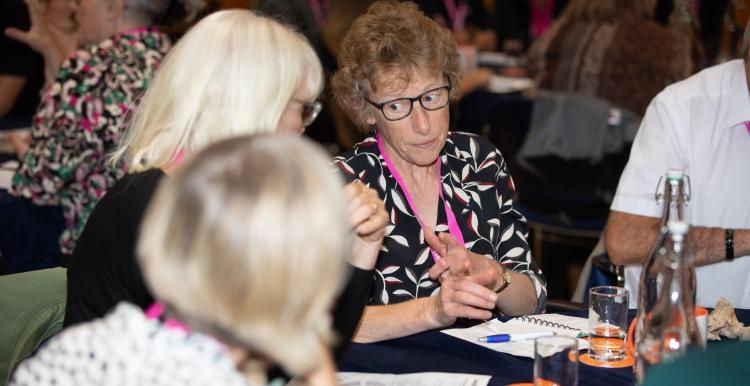
I joined the Healthwatch England Committee in September 2023 to bring the voice of local Healthwatch to committee discussions and decisions. At the time I was the Chief Executive Officer (CEO) of Healthwatch Nottingham and Nottinghamshire, a post I held for five years until I stepped down at the end of 2023.
I believe passionately in the value of local Healthwatch. We achieve some amazing things locally and nationally. But as a Healthwatch CEO I faced issues that many of you will have experienced:
- How to fulfil our huge remit across health and care with poor levels of funding (Healthwatch Nottingham and Nottinghamshire are some of the lowest-funded Healthwatch in the country based on pence per head of population). This was more difficult because of increasing multiple needs in our local communities, especially those with no voice and those experiencing health inequalities.
- Our contracts were for only three years, creating challenges with long-term planning for our strategy and impact.
- Increasing numbers of partners and groups to connect to, including four place-based partnerships and the integrated care board. These were important partnerships, but they generated yet more meetings to attend.
Like many Healthwatch, these issues limited our capacity to empower local people to have a voice and hold local NHS and care organisations to account. They limited the number of communities and providers where we could make a difference with in-depth investigation, so we could not always achieve as much impact as would have liked.
Why we need to change
Local Healthwatch are crucial. We are the only organisations with the independence and statutory power to hold health and care services to account for listening to their communities. If their voices are not heard, services will be commissioned in a way that does not work for them or excludes them altogether.
Individual local Healthwatch make their own decisions about how to prioritise, which leads to an inconsistent approach across the local Healthwatch network. As King’s College London said in its report on Healthwatch: “The diversity of the Healthwatch network … has considerable implications for equity of access to influencing health and care planning and provision for residents across England”. This affects our brand and profile.
Despite consistently raising this issue with the previous administration, Healthwatch funding has continued to decrease. Under the current economic climate this is unlikely to change. The risk is that we reach a point where delivering Healthwatch England and Healthwatch becomes financially unviable.
The total resource for Healthwatch England and the local Healthwatch network is £28m, £25m of which funds local Healthwatch. How can we work differently to achieve more and deliver a more consistent local Healthwatch offer across England, without additional funding?
What needs to happen now
Healthwatch England has led a 12-month engagement process during which chairs, lead officers and staff representing 101 local Healthwatch have contributed their views and debated the issues. A working group of representatives from ten local Healthwatch representatives has had further detailed discussions. With 153 Healthwatch it is no surprise that differing views exist. However, the need for change is something we all recognise. We now need to decide how we are going to change.
There are some things that must not change, such as our independence, and our statutory power to hold commissioners and providers to account. We have also agreed that we must not lose the localism of local Healthwatch.
Any decisions about a future Healthwatch model will be made by the Department of Health and Social Care. Healthwatch England will present the range of views to them, acknowledging the range of views within our network.
However, after carefully reviewing the options, the Healthwatch England Committee supports the model where Healthwatch England assumes the role of commissioner – a solution we heard loudly during our conversations with the Healthwatch network.
We believe that this approach offers the best solution for delivering fairer funding, a network that genuinely works as one, economies of scale for back office and governance functions, consistent terms and conditions, and uniform representation on integrated care boards.
We cannot let poor health and care become normalised.
Let's use the opportunity presented by a new government to strengthen our role in promoting the voice of patients, working together to make the biggest difference to the communities we serve.
Jane Laughton
HWE Committee Member
September 2024
Values into action - how we can all live our shared Healthwatch values
In her latest blog, Louise discusses the behaviours we can all embrace to live our values throughout the Healthwatch movement.
I want to thank each of you for contributing over the last few months to help us explore our shared values and consider what it means to put them into action. It was inspiring to hear so many great examples in my meetings with chairs and lead officers and also in my conversations with five Healthwatch leaders, which you can watch on our YouTube channel.
In case you are new or missed these discussions, I am delighted to share our five values, agreed by you, Healthwatch England staff members and our committee:
- Equity: Embracing inclusivity and compassion, establishing profound connections with the communities we serve, and empowering them.
- Collaboration: Nurturing both internal and external relationships, fostering transparent communication, and partnering to amplify our impact.
- Independence: Championing the public's agenda, serving as purposeful and critical allies to decision-makers.
- Truth: Operating with unyielding integrity and honesty, fearlessly advocating truth to those in power.
- Impact: Pursuing ambitious endeavours to effect meaningful change for individuals and communities while remaining accountable and holding others accountable.
The journey so far
When we embarked on this journey last year, we committed to ensuring that our values don't become mere words on paper. It's about embodying these values in our everyday work and interactions.
Since we collectively agreed on our five values and announced them at our National Healthwatch Impact Awards event in March 2024, we have met with several of our peer network groups to discuss what we can do to turn our values into action in our different roles.
Here are a few of the fantastic ways that you are all living our shared values.
Equity
- We establish safe, inclusive spaces where everyone can share their views and value and respect the opinions of others.
- We comply with the Equality Act 2010 in all aspects of staff recruitment and care, collect demographic data, and ensure our staff continue a learning journey on equality, diversity, equity and inclusion.
Collaboration
- We collaborate with all other local Healthwatch within our integrated care system footprint and offer feedback collectively.
- We involve providers in projects from the start to ensure their buy-in and give recommendations the best chance of being acted upon.
Independence
- We balance our critical friend role with being a valued system partner.
- We publish our decision-making process and are clear about the involvement of laypeople and volunteers.
Truth
- We challenge system and provider messages when they do not align with feedback from local people.
- We make sure all reports and insights have a solid evidence base.
Impact
- We track, record and promote outcomes and impact for our work.
- We give feedback on the difference we make to people whose experiences we have gathered.
At Healthwatch England, we’re making time to reflect on how our values and behaviours shape our work, recognising that getting this right is essential to building the culture that defines, inspires, and drives us forward.
We’ve run several sessions for staff to explore how our behaviours align with our individual roles. We’ve presented some scenarios for staff to reflect on how they can apply our values and behaviours in their work and all staff objectives include application of the values and behaviours.
We’ve asked each staff member to identify at least one behaviour to discuss with their line manager during one-to-ones – something we aim to repeat throughout the year and our National Committee will be developing a charter based on these values and behaviours.
Putting our values into action – next steps
We hope that you will:
- Share these values into action with your staff, board members, volunteers, and commissioners.
- Discuss internally which of these actions you are already taking and which you can start doing, and if there are any you think need to be added. We are confident there will be clear alignment between Healthwatch from feedback in the network meetings.
- Please watch and share these fantastic videos, in which we discuss what we can all do to bring our values to life in our everyday work.
Louise and John discuss equity
Sabrina and Louise discuss collaboration
Deborah and Louise discuss independence
Michelle and Louise discuss truth
Sarah and Louise discuss impact - Share examples of when your staff and volunteers exemplified these values in the annual Healthwatch survey.
Moving forward
Although each Healthwatch is independent, with some being part of larger organisations with their own set of values, it's crucial that we can all align with a common set of values. This cohesion resonates with our funders and stakeholders, emphasising our commitment to the communities we serve. Furthermore, it demonstrates our unity as we advocate for our future sustainability.
I'm already looking forward to our National Conference 2024, where we'll have the opportunity to reflect on these shared values.
Together, let's harness the power of our shared values to drive meaningful impact and enhance our effectiveness in serving the public.
Conversations about impact - your perspectives
In this six-minute read, Jon Turner talks with four Healthwatch leaders who have worked with their teams to develop a strong approach to impact.
Over the first few months of 2024, I talked to four local Healthwatch leaders about their approach to achieving impact. Some key themes emerged from what they told me.
The leaders were:
- Joanna Smith, Manager of Healthwatch Isle of Wight, who has been with the Healthwatch for almost ten years.
- Joy Beishon, Chief Executive of Healthwatch Greenwich, who has been in the service for five years.
- Diane Blair, Manager of Healthwatch Sefton, who has been in the service since its inception.
- Amy Salt, Engagement and Involvement Manager at Healthwatch Derbyshire, who has been in post for just over one year.
Theme 1: Our Healthwatch team believes that we exist to achieve change for local people.
Joanna: The nature of our area means the team are very aware of being accountable to residents, as people we know often ask us what we’ve achieved.
It’s so important to ensure the team has a wide outlook so that not only can they talk and engage with people, but they can also analyse what they’re hearing, spot trends and report in a way that encourages solutions.
Joy: Our team is focused on achieving tangible improvements and fostering greater equity for our residents. We recognise that our role is not just about gathering insights but translating those insights into real, actionable change. This means we are constantly analysing feedback and insight, identifying trends, and advocating for solutions that directly address the needs and concerns of our community.
Diane: The team shifted its view of who we are accountable to. Instead of seeing our main responsibility as being to provide system partners with insight, we now focus more on ensuring that residents’ insight shared with system partners is acted on and that residents are then updated with any actions and/or changes.
If a member of the public asks what we’ve achieved, we shouldn’t struggle to give a clear answer!
Amy: We know how important it is to close the loop. Going out and collecting feedback is just one element of what we do. It’s vital that we maintain strong relationships by informing the public about what’s happened with their feedback. This encourages people to keep speaking with us and view us as reputable and purposeful.
Theme 2: We see reports and recommendations as a means to an end.
Joanna: Engagement activities are essential and can be really fulfilling. They’re backed up by report writing. But all that’s only meaningful if we then try our hardest to use what we’ve got to seek improvements.
Joy: It's much easier to write a report and then move on. The real challenge — and where we can make a difference — is in the follow-up and ensuring that our recommendations lead to actual change. This means not just identifying areas for improvement but actively engaging with stakeholders, advocating for our recommendations, and tracking the implementation process.
We tailor our approach to gain leverage depending on the context and the needs of the issue at hand. Our reports are the starting point of a larger journey towards improvement, not the endpoint.
Diane: In the past, our ethos was that responsibility stopped at the point of producing our report. We worked in a way that assumed that recommendations would be picked up and didn’t do much follow-up to check what happened. We saw this as the Healthwatch role and seamlessly moved on to the next piece of work. Now, the team make more space at meetings to plan for outcomes, and we have systems in place to follow up.
Amy: By using Theory of Change in our planning we can agree how to make best use of reports and other approaches to take forward particular themes. Sometimes for example we’ll decide we’re more likely to achieve outcomes by making a direct connection with a service commissioner, producing a guide or infographic, or feeding raw data into an external strategy that’s already in development.
Theme 3: We’ve put a lot of time into developing an approach to influencing that works in our local context.
Joanna: We’ve gained agreement that all reports go to the Health Overview and Scrutiny Committee and they require providers and commissioners to report back. This not only helps achieve outcomes but also evidence them.
At the start of a piece of work, we get buy-in by hearing what all interested parties think and want to know. We see part of our role as being to link service users and decision-makers together to create solutions. We find this is much more likely to lead to useful outcomes being implemented.
Whilst we sit on the highest-level committees and groups, we understand that these are for relationship building and to be seen as a partner. The real achievements are gained at meetings and groups a tier below those.
Joy: We do our best to ensure that key decision-makers fully grasp the importance of our role and the connections we maintain with various parts of the system, including the Care Quality Commission (CQC). It’s important for our stakeholders to understand our statutory right to publish information and our duty to maintain transparency with the public. We always make it clear that our intent is to support and improve the system.
Some stakeholders occasionally perceive our relationship as somewhat adversarial, but we remind them of our role as a critical friend to provide constructive feedback aimed at driving positive change. We emphasise that while our findings may sometimes be challenging to hear, they are crucial for fostering improvement and that we are committed to working together and supporting the system to find solutions.
Diane: We always aim to make our positive intent clear to system partners. We explain at the start of a piece of work that they might not like everything they hear later on, but Healthwatch will work with them to find solutions, too. We also ask them what they’d find useful from a planned piece of work.
We send any reports to the most senior system partners and leave it to them to cascade down their own organisation as appropriate. They seem to appreciate this and maybe it even gives them a rare chance to find out what’s really happening on the ground.
Amy: Once we’ve decided on a project, we ensure we form strong connections with providers, commissioners and any other groups involved in relevant decision-making. Once we have their "buy-in", we discuss what could be changed, potential information they’d be interested in knowing about and what’s already been done. They can help co-produce the piece of work with us. It’s then much easier to follow up with them later about changes that have been achieved.
If attempts to get the provider on board with the project don’t succeed, then we decide as a team whether we’ll do the project or not. We might decide it’s important enough to go ahead anyway. However, it can be harder to get outcomes this way.
Theme 4: We’re careful to maintain our sense of independence.
Joanna: We’re very strict on avoiding any situations that might call into question our independence and impartiality. It’s important to be beyond reproach.
Joy: We find that participating in 'top table' meetings is highly effective. These forums allow us to be seen as trusted and safe participants in critical discussions that we might otherwise be excluded from. However, it's crucial to remain vigilant and not become overly enamoured with the prestige of interacting at a senior level just for the sake of it. Our primary focus is always on the value we bring to these discussions. We continually assess the purpose and productivity of our involvement, which means not hesitating to step back from meetings that do not serve a clear, beneficial purpose for our objectives.
Diane: Over time, I've become more motivated by the insight I'm bringing to a senior meeting rather than a bit flattered just to be there. If a meeting isn’t a good use of time in some way, then we’ll stop attending.
Amy: We’re clear about our independence in all our work. System partners regularly tell us that’s why they value our feedback - because we tend to get a more honest response from the public.
At engagement events, we make it clear to people that we’re independent and are there to give them a route for feedback. This is even more important when people haven’t been able to reach a provider themselves or don’t feel listened to.
Theme 5: We use Healthwatch England resources.
Joanna: The Impact Tracker has hugely developed our approach to following up.
Joy: The Impact Tracker is an invaluable tool for our team. It's increased our ability to follow up on projects and track progress. However, its effectiveness hinges on having someone in the team responsible for consistently populating and updating it.
The Annual Report template has hugely improved over the past few years. It’s now more outcome-focused and makes us think even more about tangible results and impact.
Diane: The training on impact and theory of change was a turning point for the team, making everyone stop and rethink who they were accountable to and what the point of Healthwatch work was. It wasn’t an easy shift of mindset at the start, but is now business as usual.
Our communications about our work used to be more of a descriptive narrative about the process, but we now concentrate much more on what's been achieved.
Amy: The theory of change training allowed our team to think about how we approach new pieces of work. Using this makes a big difference, not only with outcomes and impact but also by ensuring the team all share an understanding of the purpose of a piece of work.

A huge thanks to all four for taking the time to share their valuable perspectives and insights with me.
A discussion with your own Healthwatch team about the points covered here could be interesting. Do let me know if you do that and what conclusions you reach.
Jon.